GATE (Listmode Reconstruction; With Time of Flight)#
[1]:
from __future__ import annotations
import torch
import pytomography
from pytomography.metadata import ObjectMeta
from pytomography.metadata.PET import PETLMProjMeta, PETTOFMeta
from pytomography.projectors.PET import PETLMSystemMatrix
from pytomography.algorithms import OSEM
from pytomography.io.PET import gate
from pytomography.likelihoods import PoissonLogLikelihood
import os
from pytomography.transforms.shared import GaussianFilter
import matplotlib.pyplot as plt
from pytomography.utils import sss
import gc
During this script, some ROOT files generated from gate are saved as .pt tensors throughout the process. Since reading the ROOT files takes considerable time, it is recommended to just open the generated .pt files in subsequent runs of this script:
[2]:
LOAD_FROM_ROOT = False # Set to true if .pt files not generated
Required data:
[3]:
path = '/disk1/pet_mri_scan/'
# Macro path where PET scanner geometry file is defined
macro_path = os.path.join(path, 'mMR_Geometry.mac')
# Get information dictionary about the scanner
info = gate.get_detector_info(path = macro_path,
    mean_interaction_depth=9, min_rsector_difference=0)
# Paths to all ROOT files containing data
paths = [os.path.join(path, f'gate_simulation/simple_phantom/mMR_voxBrain_withSimplePhantom_{i}.root') for i in range(1, 55)]
We can look at the information of our PET scanner:
Set up time of flight metadata:
Since GATE tracks the times, the time of flight bins can be set up however one wishes. The only thing that is dependent on the GATE simulation is
fwhm_tof_resolution, which in our case is 550psDepending on the computing resources you have, you may need to lower the number of TOF bins for scatter estimation to avoid memory errors
[4]:
speed_of_light = 0.3 #mm/ps
fwhm_tof_resolution = 550 * speed_of_light / 2 #ps to position along LOR
TOF_range = 1000 * speed_of_light #ps to position along LOR (full range)
num_tof_bins = 21
tof_meta = PETTOFMeta(num_tof_bins, TOF_range, fwhm_tof_resolution, n_sigmas=3)
Normalization Correction#
In PET imaging, each detector crystal used in the scanner will have a different response to a uniform source due to its positioning (e.g. crystals at the end of edge of modules are different than those in the center). Adequate PET reconstruction takes this into account by first performing a calibration scan for a scanner and obtaining a normalization correction factor for each crystal pair LOR
The cell below only needs to be ran once, and may take a long time, as it requires opening and parsing through all the ROOT files corresponding to the normalization scan. Once it is ran, the normalization weights corresponding to each pair of detector IDs will be obtained (due to geometry/crystal orientation).
This particular calibration scan was done using a thin cylindrical shell. We can compute \(\eta\) using a particular function in the gate functionality of PyTomography. Then we save it as a torch.Tensor file for easy access in the next part. For this we need
cylinder_radius: The radius of the thin cylindrical shell used for calibration
[5]:
if LOAD_FROM_ROOT:
    normalization_paths = [os.path.join(path, f'normalization_scan/mMR_Norm_{i}.root') for i in range(1,37)]

    # Get normalization weights for all possible detector ID pairs
    normalization_weights = gate.get_normalization_weights_cylinder_calibration(
        normalization_paths,
        info,
        cylinder_radius = 318, # mm (radius of calibration cylindrical shell,
        include_randoms=False
    )

    torch.save(normalization_weights, os.path.join(path, 'normalization_weights.pt'))
normalization_weights = torch.load(os.path.join(path, 'normalization_weights.pt'))
Primary-Only Reconstruction#
Before we delve into scatter/random modeling, lets get a baseline reconstruction that uses only primary events from the simulated GATE data (i.e. we will manually exclude all scatters/randoms). We can use PyTomography functionality to select for such events when we open the ROOT data. Obviously this is not doable for clinical data (where we don’t know which events are randoms/scatters).
[6]:
if LOAD_FROM_ROOT:
    detector_ids = gate.get_detector_ids_from_root(
        paths,
        info,
        tof_meta = tof_meta,
        include_randoms=False,
        include_scatters=False)
    detector_ids = detector_ids[detector_ids[:,2]>-1] # For TOF, only take events within the TOF bins
    torch.save(detector_ids, os.path.join(path, 'detector_ids_tof21bin_primary_only.pt'))
detector_ids = torch.load(os.path.join(path, 'detector_ids_tof21bin_primary_only.pt'))
We reconstruct PET listmode data as follows:
Note: in this case, our sensitivity weights only have contribution from the normalization factor \(\eta\) (and not attenuation \(\mu\)), so we need to include the attenuation map in the system matrix to get the true sensitivity weights
[7]:
# Specify object space for reconstruction
object_meta = ObjectMeta(
    dr=(2,2,2), #mm
    shape=(128,128,96) #voxels
)
# Get projection space metadata from PET geometry information dictionary
proj_meta = PETLMProjMeta(
    detector_ids,
    info,
    tof_meta=tof_meta,
    weights_sensitivity=normalization_weights
    )
# Get attenuation map and PSF transform from the associated phantom
atten_map = gate.get_aligned_attenuation_map(os.path.join(path, 'gate_simulation/simple_phantom/umap_mMR_brainSimplePhantom.hv'), object_meta).to(pytomography.device)
psf_transform = GaussianFilter(3.) # 4mm gaussian blurring
# Create system matrix.
system_matrix = PETLMSystemMatrix(
    object_meta,
    proj_meta,
    obj2obj_transforms = [psf_transform],
    attenuation_map = atten_map,
    N_splits=8,
)
# Create likelihood. For listmode reconstruction, projections don't need to be provided, since all detection events are stored in proj_meta
likelihood = PoissonLogLikelihood(
    system_matrix,
)
# Initialize reconstruction algorithm
recon_algorithm = OSEM(likelihood)
# Reconstruct
recon_primaryonly = recon_algorithm(n_iters=4, n_subsets=14)
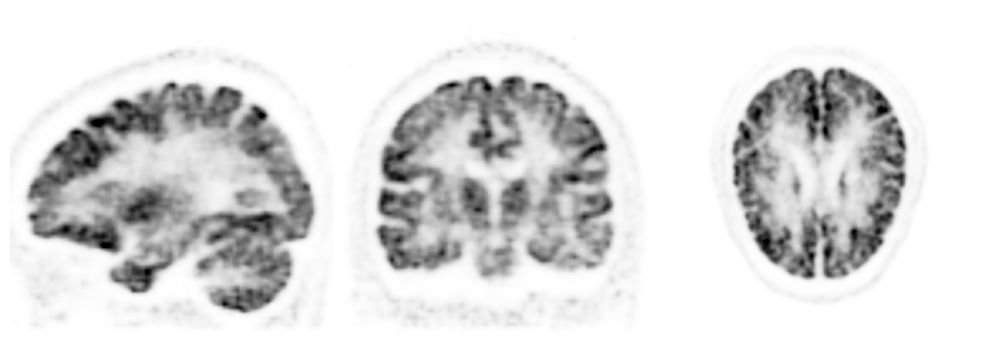
[8]:
vmax = 0.45
cmap='Greys'
fig, ax = plt.subplots(1,3,figsize=(10,4), gridspec_kw={'wspace': 0.0})
plt.subplot(131)
plt.imshow(recon_primaryonly[50,16:-16].cpu().T, cmap=cmap, interpolation='gaussian', vmax=vmax, origin='lower')
plt.axis('off')
plt.subplot(132)
plt.imshow(recon_primaryonly[16:-16,64].cpu().T, cmap=cmap, interpolation='gaussian', vmax=vmax, origin='lower')
plt.axis('off')
plt.subplot(133)
plt.imshow(recon_primaryonly[:,:,48].cpu().T, cmap=cmap, interpolation='gaussian', vmax=vmax, origin='lower')
plt.axis('off')
fig.tight_layout()
plt.show()
Reconstruction With Random/Scatter Estimation#
For reconstruction of all events, we need to estimate boths randoms and scatters. Lets now get all events that were obtained in GATE:
[9]:
if LOAD_FROM_ROOT:
    detector_ids = gate.get_detector_ids_from_root(
        paths,
        info,
        tof_meta=tof_meta
        )
    detector_ids = detector_ids[detector_ids[:,2]>-1] # For TOF, only take events within the TOF bins
    torch.save(detector_ids, os.path.join(path, 'detector_ids_tof21bin_all_events.pt'))
detector_ids = torch.load(os.path.join(path, 'detector_ids_tof21bin_all_events.pt'))
Randoms#
In addition to the first two steps of the non-TOF procedure (obtaining a random sinogram and smoothing), we now also need to account for the fact that the number of randoms in each TOF bin is proportional to the length of the TOF bin divided by the total coincidence timing width. We can do this using the randoms_sinogram_to_sinogramTOF function, and then converting back to listmode.
First lets get all the delayed coincidence events:
[10]:
if LOAD_FROM_ROOT:
    detector_ids_delays = gate.get_detector_ids_from_root(
        paths,
        info,
        substr = 'delay')
    torch.save(detector_ids_delays, os.path.join(path, 'detector_ids_delays.pt'))
detector_ids_delays= torch.load(os.path.join(path, 'detector_ids_delays.pt'))
The procedure is
Convert listmode delays to sinogram
Smooth sinogram
Convert sinogram to TOF sinogram
Convert TOF sinogram to TOF listmode events
[11]:
sinogram_randoms_estimate = gate.listmode_to_sinogram(
    detector_ids_delays,
    info
)
sinogram_randoms_estimate = gate.smooth_randoms_sinogram(
    sinogram_randoms_estimate,
    info,
    sigma_r=4,
    sigma_theta=4,
    sigma_z=4
)
sinogram_randoms_estimate = gate.randoms_sinogram_to_sinogramTOF(
    sinogram_randoms_estimate,
    tof_meta = tof_meta,
    coincidence_timing_width = 4300
) # coinicidence timing window for this GATE simulation was set to 4300ps
lm_randoms_estimate = gate.sinogram_to_listmode(
    detector_ids,
    sinogram_randoms_estimate,
    info,
)
Scatters#
Like before (non-TOF listmode tutorial), lets get an initial reconstruction without scatter
[12]:
atten_map = gate.get_aligned_attenuation_map(os.path.join(path, 'gate_simulation/simple_phantom/umap_mMR_brainSimplePhantom.hv'), object_meta).to(pytomography.device)
normalization_weights = torch.load(os.path.join(path, 'normalization_weights.pt'))
proj_meta = PETLMProjMeta(
    detector_ids,
    info,
    weights_sensitivity=normalization_weights,
    tof_meta=tof_meta
    )
psf_transform = GaussianFilter(3.)
system_matrix = PETLMSystemMatrix(
       object_meta,
       proj_meta,
       obj2obj_transforms = [psf_transform],
       N_splits=10,
       attenuation_map=atten_map.to(pytomography.device),
)
lm_norm = system_matrix._compute_sensitivity_projection(all_ids=False)
additive_term = lm_randoms_estimate / lm_norm
additive_term[additive_term.isnan()] = 0 # remove NaN values
# Provide the random-only
likelihood = PoissonLogLikelihood(
        system_matrix,
        additive_term = additive_term
    )
recon_algorithm = OSEM(likelihood)
recon_without_scatter_estimation = recon_algorithm(4,14)
Now we perform the scatter estimate and convert back to listmode (like in the previous non-TOF tutorial). There are two additional parameters we need to provide to the function for TOF:
tof_meta: Provides all the required TOF metadatanum_dense_tof_bins: The emission integrals in Watson [CITE] are split into multiple regions: this specifies the number of regions. This is independent and seperate from any of the information intof_meta.
Note: this takes ~10 minutes to run
[13]:
scatter_sinogram = sss.get_sss_scatter_estimate(
        object_meta,
        proj_meta,
        recon_without_scatter_estimation,
        atten_map,
        system_matrix,
        sinogram_random=sinogram_randoms_estimate,
        tof_meta=tof_meta,
        num_dense_tof_bins=25,
        image_stepsize=6,
        sinogram_interring_stepsize=6,
        sinogram_intraring_stepsize=6,
        N_splits=1)
lm_scatter_estimate = gate.sinogram_to_listmode(proj_meta.detector_ids, scatter_sinogram, proj_meta.info)
# Save memory, these are not needed anymore
del(scatter_sinogram)
del(sinogram_randoms_estimate)
gc.collect()
[13]:
32
Finally, we can perform the reconstruction including both scatters and randoms for estimation.
[14]:
additive_term = (lm_scatter_estimate + lm_randoms_estimate) / lm_norm
additive_term[additive_term.isnan()] = 0
likelihood = PoissonLogLikelihood(
        system_matrix,
        additive_term = additive_term
    )
recon_algorithm = OSEM(likelihood)
recon_lm_tof = recon_algorithm(4,14)
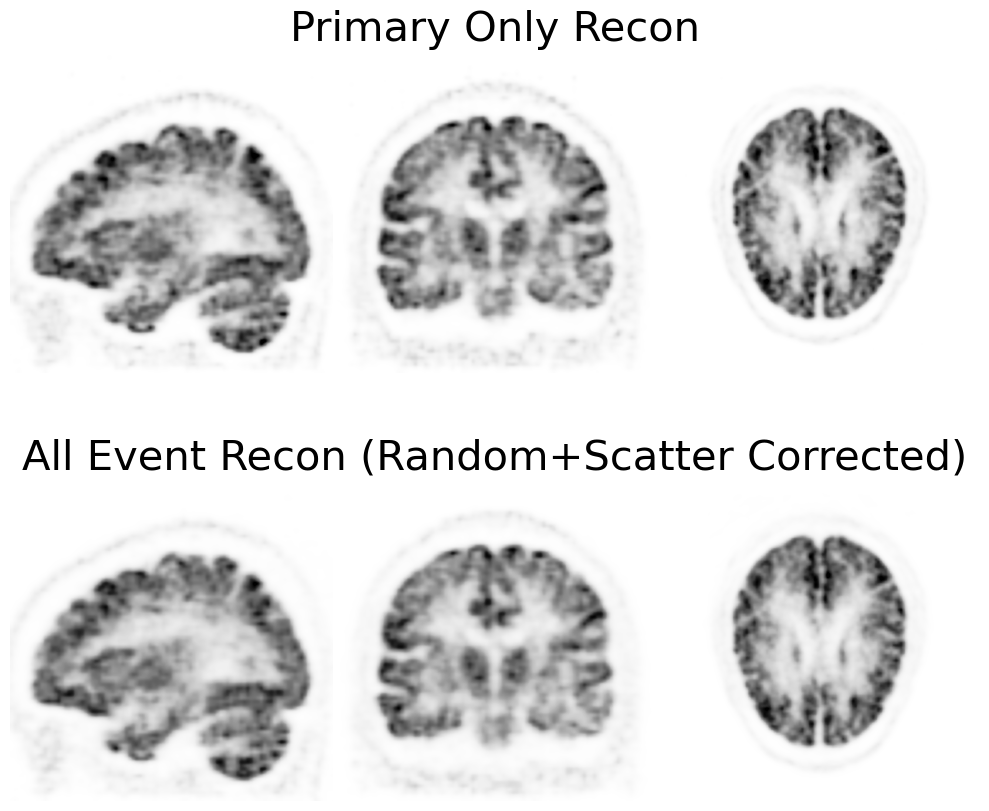
[15]:
vmax = 0.45
cmap = 'Greys'
fig, ax = plt.subplots(2,3,figsize=(10,9), gridspec_kw={'wspace': 0.0})
plt.subplot(231)
plt.imshow(recon_primaryonly[48,16:-16].cpu().T, cmap=cmap, vmax=vmax, interpolation='gaussian', origin='lower')
plt.axis('off')
plt.subplot(232)
plt.imshow(recon_primaryonly[16:-16,64].cpu().T, cmap=cmap, vmax=vmax, interpolation='gaussian', origin='lower')
plt.title('Primary Only Recon', fontsize=30)
plt.axis('off')
plt.subplot(233)
plt.imshow(recon_primaryonly[:,:,48].cpu().T, cmap=cmap, vmax=vmax, interpolation='gaussian', origin='lower')
plt.axis('off')
plt.subplot(234)
plt.imshow(recon_lm_tof[48,16:-16].cpu().T, cmap=cmap, vmax=vmax, interpolation='gaussian', origin='lower')
plt.axis('off')
plt.subplot(235)
plt.imshow(recon_lm_tof[16:-16,64].cpu().T, cmap=cmap, vmax=vmax, interpolation='gaussian', origin='lower')
plt.axis('off')
plt.title('All Event Recon (Random+Scatter Corrected)', fontsize=30)
plt.subplot(236)
plt.imshow(recon_lm_tof[:,:,48].cpu().T, cmap=cmap, vmax=vmax, interpolation='gaussian', origin='lower')
plt.axis('off')
fig.tight_layout()
plt.show()